

The following article first appeared in the July-August 2025 issue of the Iowa History Journal.
The train rolled into the Illinois Central Railroad depot with Charles Comiskey’s 1914 Chicago White Sox aboard. It was not the first-time baseball’s “Old Roman” brought one of his professional baseball teams to his adopted hometown of Dubuque, Iowa. Thirty-two years earlier Comiskey brought the 1882 St. Louis Browns to Dubuque aboard the Flying Dutchman to attend his wedding to Nancy “Nan” Kelly at St. Raphael’s Cathedral.
Comiskey – who was born in Chicago on Aug. 15, 1859 – first came to Dubuque in 1878 to work for his college mate Ted Sullivan, who had a franchise with the Western News Agency selling newspapers, books, and confectionary goods to travelers on the Illinois Central Railroad in and out of Dubuque. Comiskey also came to Dubuque to play baseball for Sullivan, who co-founded the Northwestern League. There Comiskey played for the Dubuque Red Stockings and the team won the league’s 1879 inaugural pennant. Comiskey met his best friend, Tom Loftus, on the Dubuque team.
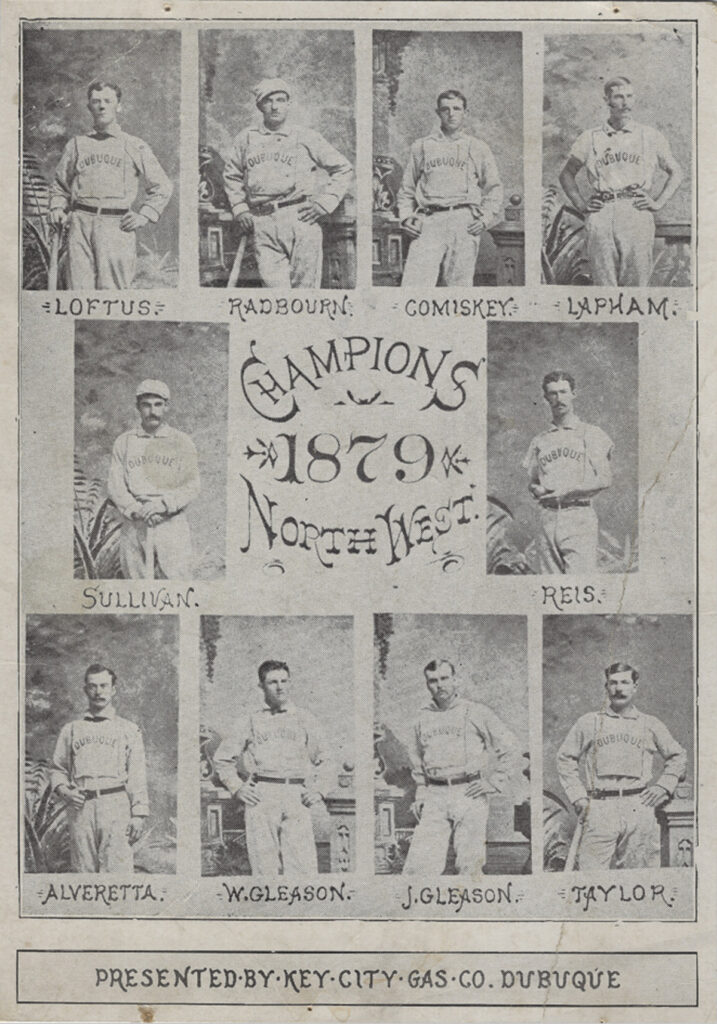
Broadside of the Dubuque Reds, Champions of the 1879 Northwestern League. Hundreds were sold via mail and in person at the photographer’s gallery or at Lapham & Reis billiards hall. Lapham and Ries were players on the ’79 Reds. (Photograph by Mackenzie & Co., Dubuque)
Dubuque gained the baseball world’s attention on Aug. 4, 1879, when Cap Anson and the National League Chicago White Stockings – today’s Chicago Cubs organization – were in Dubuque to play an off-day exhibition game and were beaten 1-0 by the champions of the Northwestern League. Thirty-two years later, while being interviewed during a Vaudeville stop in Dubuque, Anson pulled from a scrapbook the original box score from the 1879 game in Dubuque. Anson reminisced about the game and how Dubuque’s young pitcher, future Hall of Famer Charles Radbourn, was “a revelation” to Chicago with his “deceptive down shoot” pitch, the equivalent of a curveball.
Comiskey’s four years playing baseball in Dubuque while working for Sullivan at the railroad depot kept him in Dubuque year-round. During this time Comiskey met a young Dubuque girl and fell in love. On April 12, 1882, Comiskey married Nan Kelly. That same year the newlyweds took in Nan’s niece, Mable Fredericks, upon the death of her father and raised her as their own.
On Jan. 13, 1884, Charles A. Comiskey Jr. was born. The first son born to the Comiskeys was not long for this world, however, as he died four days later. The Comiskeys buried their son in Mt. Olivet Cemetery in Key West. The following year a second son was born. John Louis “Lou” Comiskey would maintain ties to Dubuque his entire life.
Comiskey started his professional baseball career as a pitcher for Dubuque. But a weak arm combined with Radbourn as starting pitcher forced Sullivan to move Comiskey to first base. Comiskey is recognized as revolutionizing first base play by being the first player to play off the base, an innovative change Comiskey developed while in Dubuque. Malcolm MacLean, sportswriter for the Chicago Evening Post, wrote in 1913 how “Comiskey revolutionized first base play in Dubuque freight yards.”
While practicing with Sullivan in the freight yards near the warehouses where the train merchants, including Sullivan and Comiskey, would replenish their supplies for sale on the next Illinois Central train in or out of Dubuque, Comiskey began to change how fielders played first base. Traditionally first basemen stood on the base awaiting a ball to be hit and thrown to them. Using a brick for first base Comiskey would practice playing away from the “base” while Sullivan hit ground balls towards him. Comiskey played further and further away from the base as Sullivan hit harder grounders to his right. It was at this time Comiskey came up with the idea of having the pitcher cover first base while the first baseman fielded the grounder. Sullivan and Comiskey would incorporate what they learned during practice into their on-field play in 1880 and 1881.
Comiskey was a fan favorite during his time playing in Dubuque. Surrounding towns like Dyersville, Manchester, and Waterloo, Iowa, Galena, Ill., and Prairie du Chien, Wis., enjoyed watching Sullivan, Loftus, Comiskey and the team roll into town on the steel rail and play their local boys for the honors of claiming victory on the field of play. Comiskey had experience playing baseball in Prairie du Chien prior to moving to Dubuque. John Comiskey sent his son to St. John’s College in Prairie du Chien in 1873, where Comiskey played on the school team. The next year, Comiskey’s father sent him to St. Mary’s College in Kansas, where he met Sullivan. Comiskey was always a fan favorite in Dyersville, home to the Field of Dreams Movie Site. The Dyersville Commercial reported after a game in 1880, “Charlie Comiskey is a favorite with Dyersville audiences and was the recipient of great praise for his fine first base play.”
Comiskey left Dubuque for St. Louis in the spring of 1882 to start his major league career playing for the St. Louis Browns of the American Association. A year later, Comiskey started his stint as a player/manger, guiding St. Louis to four straight American Association pennants and a world’s championship in 1886. He became the team’s full-time manger in 1885. Comiskey lived in St. Louis during the baseball season while Nan and the children remained in Dubuque. Comiskey would return to Dubuque for the off season or when he was injured. In 1887 Comiskey moved his wife and children to St. Louis to be with him during the season. The couple still wintered in Dubuque until 1891, when the family permanently made Chicago their home.
1889 Old Judge baseball card of Tom Loftus, manager of the NL Cleveland Spiders. (Goodwin & Co., 1889, New York)
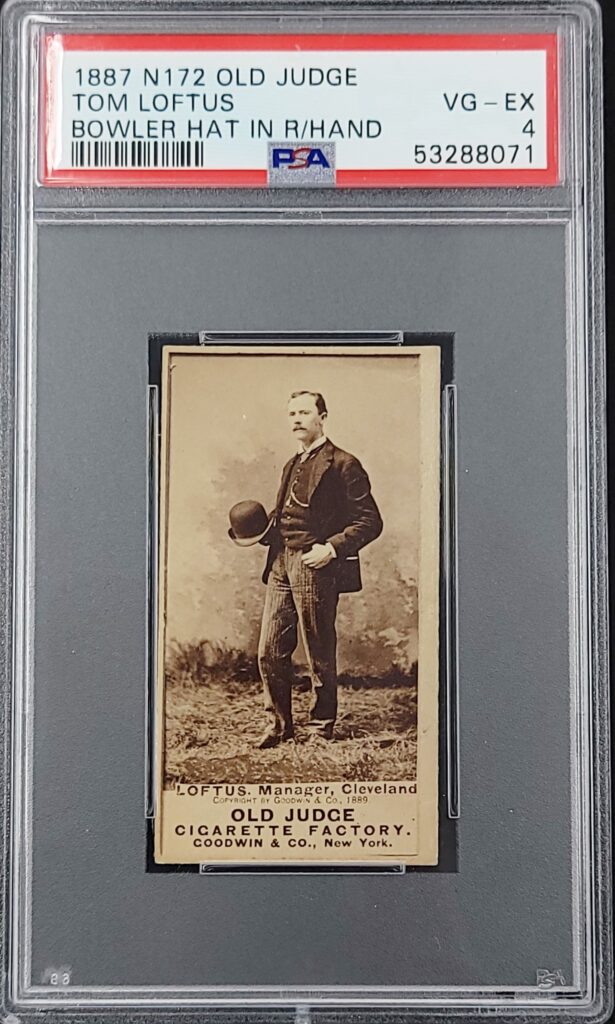
The last phase of Comiskey’s major league career as a player/manager was with the Chicago Pirates in the Players’ League (1890), the Browns again in 1891, and the Cincinnati Reds (1892-94) in the National League. Comiskey joined the Reds as player/manager replacing his best friend Tom Loftus as team manager. Loftus quit baseball after the 1891 season to return to Dubuque to focus on his business interests. Loftus had moved to Dubuque in early 1879 to play for Dubuque in the Northwestern League and never left, marrying Anna Kirk and raising two sons in the Key City. Loftus had built up a business outside of baseball with profitable investments in land and lead mining, liquor distribution, and operating saloons and lunch counters in various Dubuque businesses like the Julien Hotel and the Bank & Insurance Building.
During their time managing the Cincinnati Reds, Loftus and Comiskey became friends and mentors to a young sports editor by the name of Ban Johnson. Comiskey was instrumental in helping Johnson become president of the 1894 Western League, which was originally founded in 1885 by Sullivan and Loftus after the collapse of the Union Association, a major league that lasted only one season.
In the fall 1894 Comiskey retired from the major leagues and became owner of the Sioux City Cornhuskers in Sioux City of the Western League. He moved the team to St. Paul, Minn., and renamed it the St. Paul Saints. During his thirteen-year major league career, Comiskey posted a .264 batting average with 29 home runs, 833 RBI and 419 stolen bases. As a manager his record was 839-540-29, with a .608 win percentage.
The following spring Loftus got back into baseball as president of the Central Interstate League and the league’s Dubuque team. At the end of the 1895 season, Loftus joined Comiskey and Johnson in the Western League as owner/manager of the Columbus Senators. Collectively Johnson, Comiskey, and Loftus would be the driving force behind the Western League and its evolution into the American League.
The 1895 baseball season started on April 20 in Dubuque with the inauguration of a new professional baseball park at 27th & Washington streets. The two teams facing off that day were Loftus’ Dubuque Colts against Comiskey’s St. Paul Saints. St. Paul won 17-6. Comiskey would bring his Saints back to Dubuque for a Western League game against the Detroit Tigers on July 18, defeating Detroit, 7-6.
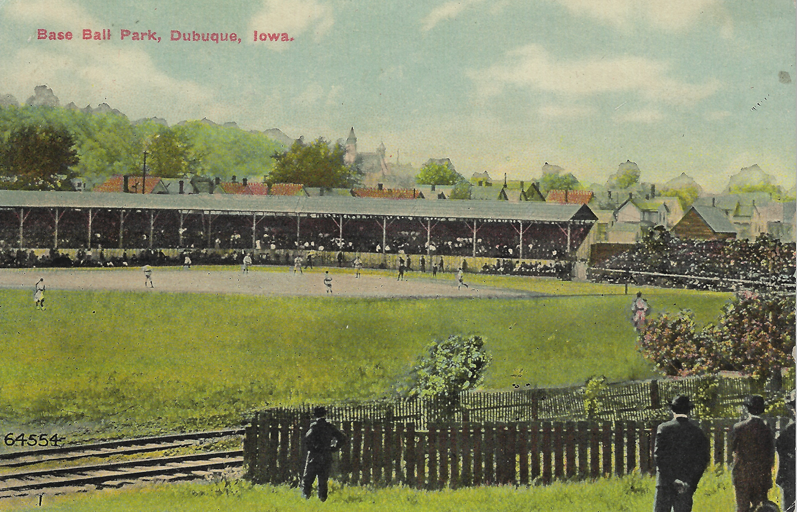
Dubuque’s League Park at 27th & Washington streets, circa 1910. The park opened in 1895 with a game between Comiskey’s St. Paul Saints and Loftus’ Dubuque Colts. (Photograph by Peter Hoffmann)
Comiskey returned to Dubuque during the 1898 baseball season for a league-sanctioned three-game series between the Saints and Loftus’ Senators. Columbus took the series 2-1. It was during this time Comiskey, Loftus, Johnson, and other Western League team owners started meeting in Dubuque, Chicago, and Milwaukee to plan for battle with the National League owners, which would result in their reorganization into the American League. As part of that evolution Comiskey’s Saints became the Chicago White Sox and Loftus’ Senators became the Cleveland Indians.
In 1896, Johnson, Comiskey, and Loftus started privately meeting in Dubuque along with other league owners to discuss business. Dubuque was preferable over Chicago due to the absence of an overbearing press wanting a news scoop. In 1898, meetings in Dubuque and Chicago started to focus on the league becoming a major league equal to the National League. An opportunity arose when the NL St. Louis Browns came up for sale. The league decided Loftus should bid on the St. Louis team. It was generally believed around the nation that Loftus and Comiskey were teaming up to buy the Browns.
Loftus nor Comiskey bid on the Browns, opting to let the owners of the NL Cleveland Spiders purchase the club and move their Spiders to St. Louis, abandoning the Cleveland baseball market to the Western League. This opened the way for Loftus to move Columbus to Cleveland as a first step towards major league status. Cleveland was owned by the Robison brothers who were raised in Dubuque before going off to college and moving to Cleveland.
On July 15, 1899, newswires across the country carried the first stories reporting the formation of a new major league to rival the NL. The Cincinnati Commercial Tribune published several stories including one with a dateline from Dubuque reporting, “It is stated here that Ban Johnson, Jimmy Manning, Charles Comiskey and Tom Loftus are planning for a new baseball league for next season… In an interview tonight Loftus admitted there was something in the scheme, and arraigns the National League, pronouncing its policy narrow and arbitrary.” In October the Western League renamed itself the American League.
Comiskey moved his Saints to the South Side of Chicago in 1900 and renamed them the Chicago White Stockings – which was also the original name of the Cubs – to compete in the newly-formed American League. The team’s name would eventually become the White Sox, an organization that is celebrating its 125th anniversary this year.
It was around this time Comiskey started a tradition with Loftus going on hunting and fishing trips up and down the Mississippi River Valley, venturing from Dubuque into the wilds of Iowa, Minnesota, and Wisconsin with friends. Comiskey would become well known for these adventures and sport figures and friends alike clamored to be included. Taking a page from Loftus, Comiskey purchased a houseboat in 1905 he named the White Sox and kept docked in Dubuque for his outdoor adventures.
Comiskey and Loftus’ friendship was widely known and written about in sports columns around the nation. When Loftus became ill in 1910 – the same year Comiskey oversaw the construction of Chicago’s Comiskey Park – Comiskey stayed in regular communication with Loftus’ wife and sons in Dubuque. Both Comiskey and Sullivan rushed to Dubuque in April upon hearing Loftus was on his death bed. On April 16 the baseball world mourned the news of Loftus’ death. Few grieved more than his best friend Comiskey. Among the pallbearers at Loftus’ funeral at St. Raphael’s Cathedral were Comiskey, Sullivan, and Johnson. Graveside services were held 50 yards from where Comiskey buried his first born, making the day exceptionally difficult for the Old Roman.
In 1914, the city of Dubuque hosted Charles Comiskey Day on June 23 to honor its adopted son, who had just returned from a triumphant world tour with his White Sox and John McGraw’s New York Giants. Accompanying Comiskey on the tour was organizer Sullivan and Iowa native, rookie Red Faber. Born in Cascade, Iowa, Faber started his professional baseball career playing minor league ball for Dubuque in the Three-I League. Faber would be elected to the National Baseball Hall of Fame in 1964. Comiskey’s White Sox played the Dubuque Hustlers that day, winning 11-2.
Comiskey brought the White Sox to Dubuque for two more exhibition games in 1915 and 1916. This time the Sox were being managed by Clarence “Pants” Rowland. Rowland was born in Platteville, Wisc., and grew up in Dubuque. Rowland got his start in baseball playing for the local team. In 1903, Rowland led the effort to establish the Dubuque entry in the Three-I League. Rowland became a protégé to Loftus and Comiskey, and in 1915, Comiskey made Rowland the manager of the White Sox. The Sox beat Dubuque in 1915 4-1. In 1916, the White Sox arrived in Dubuque for a game against St. Joseph’s College – today’s Loras College. Playing for the White Sox was its star outfielder “Shoeless Joe” Jackson, who went 3-4 in the Sox 8-0 win.
Comiskey, Rowland, and Faber went on to win the 1917 World Series against McGraw’s Giants. Faber, the star of the series, won three of Chicago’s four games, making Comiskey a world champion once again. Rowland was released after the 1918 season and Faber was out during the ill-fated 1919 World Series due to illness. Hall of Fame catcher Ray Schalk claimed if Faber was healthy in 1919, there would not have been a Black Sox scandal. Comiskey’s Dubuque friends and all the local White Sox rooters stayed loyal and sympathetic to Comiskey during and after the scandal.
The city of Dubuque wished to permanently honor Comiskey in 1929 by renaming the park at 24th and Jackson streets to Comiskey Field – today’s Comiskey Park. The field was the site where the 1879 Dubuque Reds played and overcome the NL champion Chicago White Stockings to win national fame. The Old Roman intended to be present for the dedication on June 20, 1929, but was unable to attend due to declining health.
Comiskey’s family, numerous Dubuque and Chicago friends, and Faber were all in attendance for the dedication. Comiskey’s son Lou and his family were present. Lou’s 12-year-old daughter Dorothy spoke to the crowd on her grandfather’s behalf and officially unveiled the field marker. She expressed her grandfather’s appreciation for the honor, his regret for being unable to attend, and his undying love for the city and citizens of Dubuque.
Comiskey died on Oct. 26, 1931, at his Wisconsin home. Comiskey was in the fourth class of inductees enshrined into the National Baseball Hall of Fame in 1939. Fellow inductees that year included Anson, Radbourn, and Lou Gehrig.
In 1954 the Dubuque-Comiskey connection resurfaced when Charles “Chuck” A. Comiskey II, vice president of the Chicago White Sox in charge of developing their minor league system, affiliated with the newly formed Dubuque Packers of the Mississippi-Ohio Valley League.
Chicago White Sox V.P. Charles “Chuck” A. Comiskey II Dubuque Packers president John Petrakis with the Sporting News Executive of the Year award. The younger Comiskey was dedicated to baseball in Dubuque just like his father, Lou Comiskey, and his grandfather. (AP Wirephoto, 1960)

Comiskey’s reputation after the 1919 Black Sox scandal remained unstained in Dubuque and around the baseball world. It wasn’t until the release of Eliot Asinof’s 1963 book “Eight Men Out”when Comiskey’s reputation suffered in part due to assumption, innuendo and lack of facts made available to its author at the time it was published. During the past 15 years researchers with the Society for American Baseball Research (SABR.org) have disproven the allegations against Comiskey regarding the Black Sox scandal. Tim Hornbaker’s 2014 book “Turning the Black Sox White: The Misunderstood Legacy of Charles A. Comiskey” puts to rest accusations against Comiskey and restores his reputation to the status that led to his induction into the National Baseball Hall of Fame.